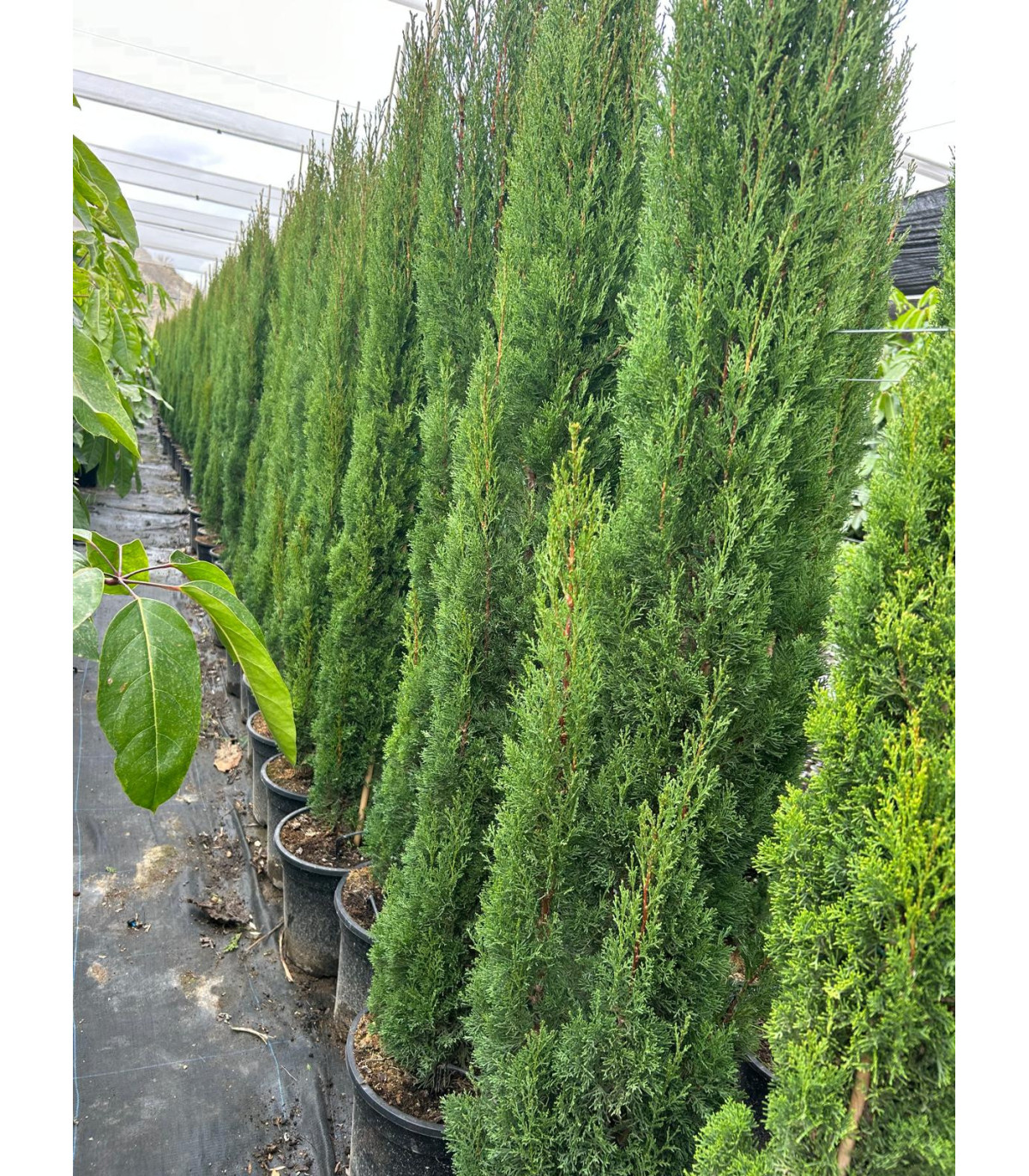
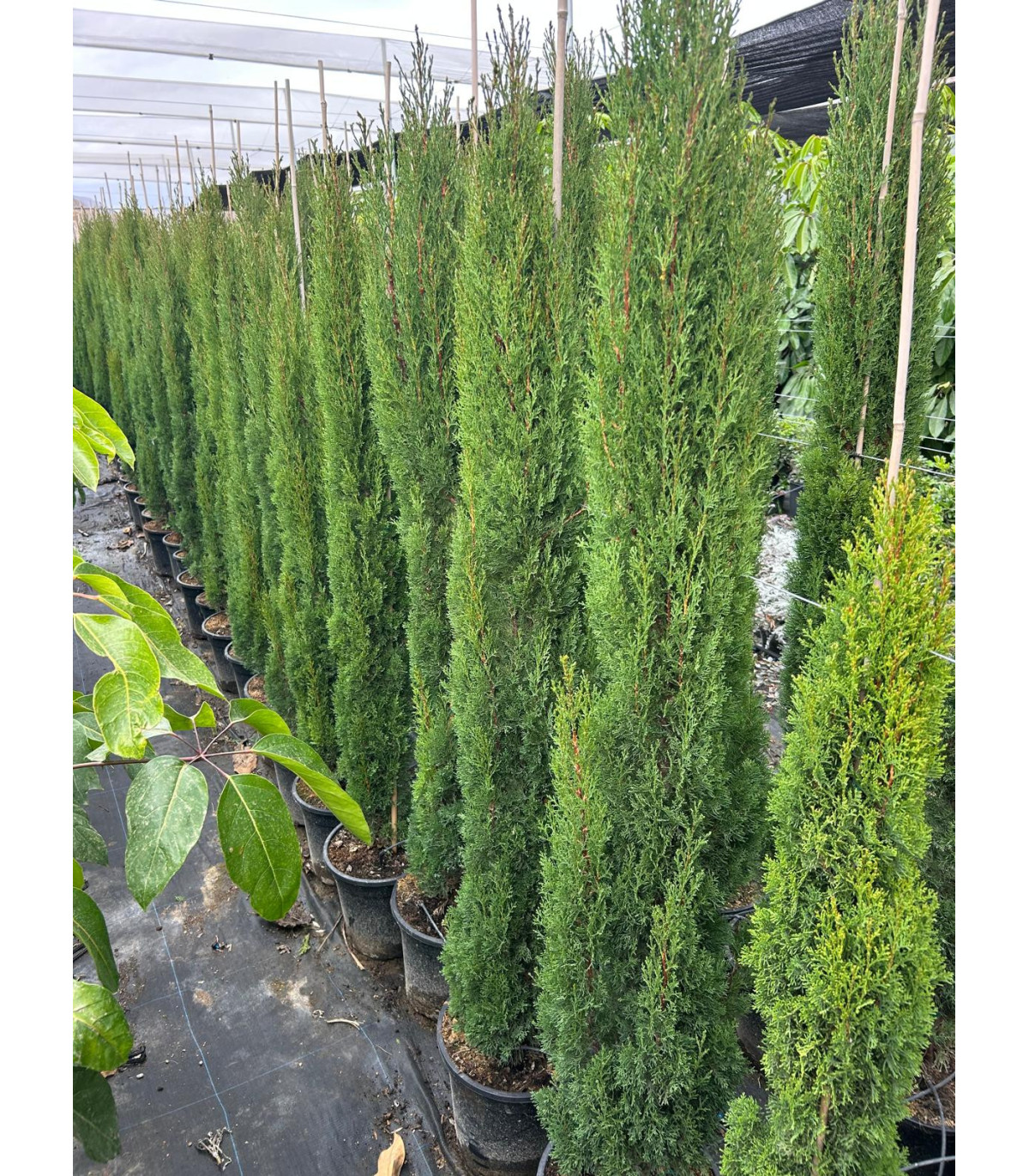
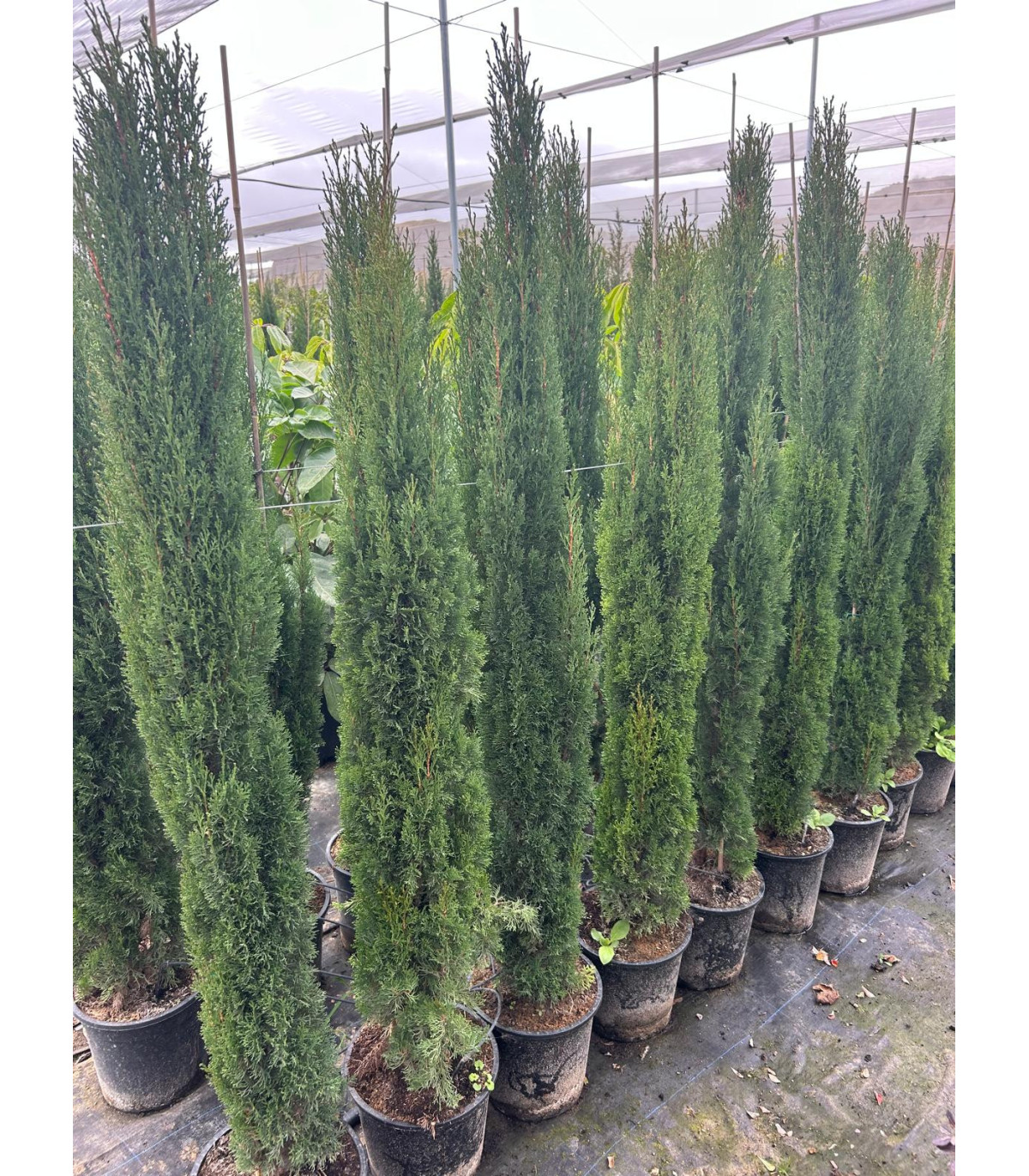
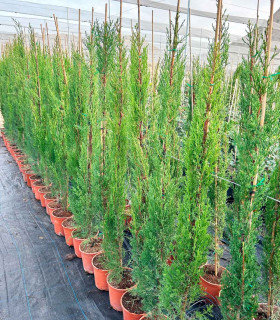

The common cypress is a conifer native to the eastern Mediterranean countries, with a columnar, narrow, and compact shape, and a deep green color. It has a round fruit 2-3 cm in diameter.
Common cypress (Curpesus sempervirens) variety Totem, more compact and lighter green in color. It is the most commonly used cypress for making pathways in Tuscany (Italy).
The common cypress is a conifer native to the eastern Mediterranean, with a columnar, narrow, and compact form and a deep green color. It produces a round fruit, 2-3 cm in diameter, called a cypress nut, which is bright green at first and turns dark grayish-brown when ripe. In its first year, it develops deep roots, but these can spread superficially; therefore, in areas with strong winds, it is best to plant it in sheltered locations. Its distinctive silhouette is best maintained with light but regular pruning.
Its cultivation is ancient, and for centuries it has been one of the most characteristic elements of Mediterranean Italy and France. It is extremely long-lived and adapts to all types of soil, including poor, arid, clayey, and calcareous ones.
Physiological and cultivation characteristics:
- It can reach a height of 18 to 22 meters and a width of 1 to 2 meters.
- It belongs to rusticity zone 8.
- It is fast-growing.
- It should be in an area with full sun or partial shade.
- It has fragrant leaves.
- Suitable for small gardens.
- Suitable for parks or large gardens.
- Suitable for planting as a standalone specimen.
- Suitable for forming groups (more plants of the same variety).
- Suitable for creating shaped hedges.
- Suitable for the formation of windbreak barriers.
- Suitable for street trees, squares and narrow roads.
- Wind resistant.
- It withstands the sea.