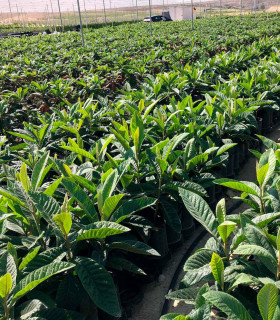

The loquat is a large evergreen shrub or small tree with a rounded crown, native to Japan. Its Latin scientific name is Eriobotrya japonica. It has large leaves, 12-15 cm long.
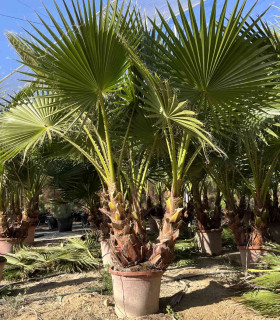
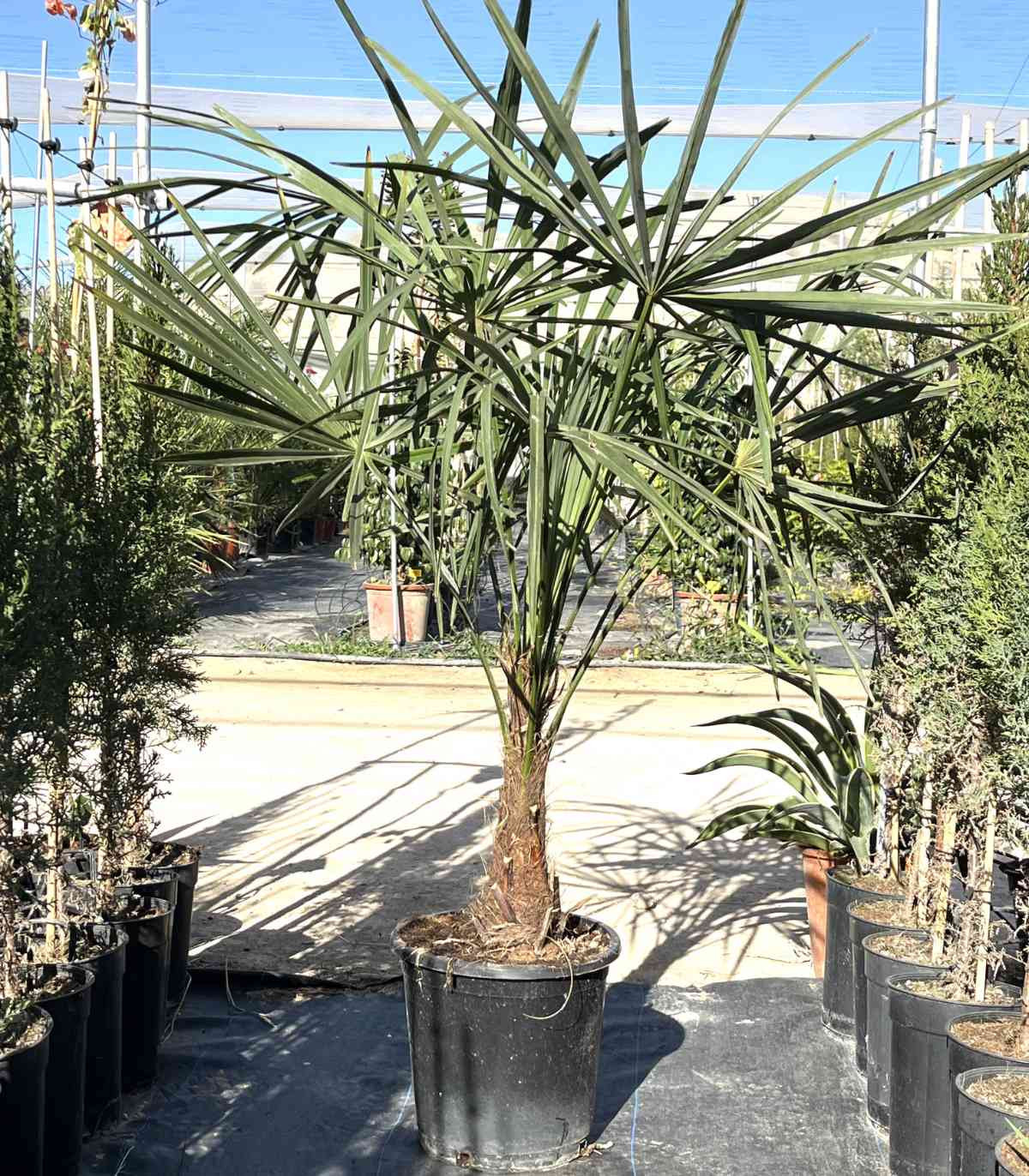
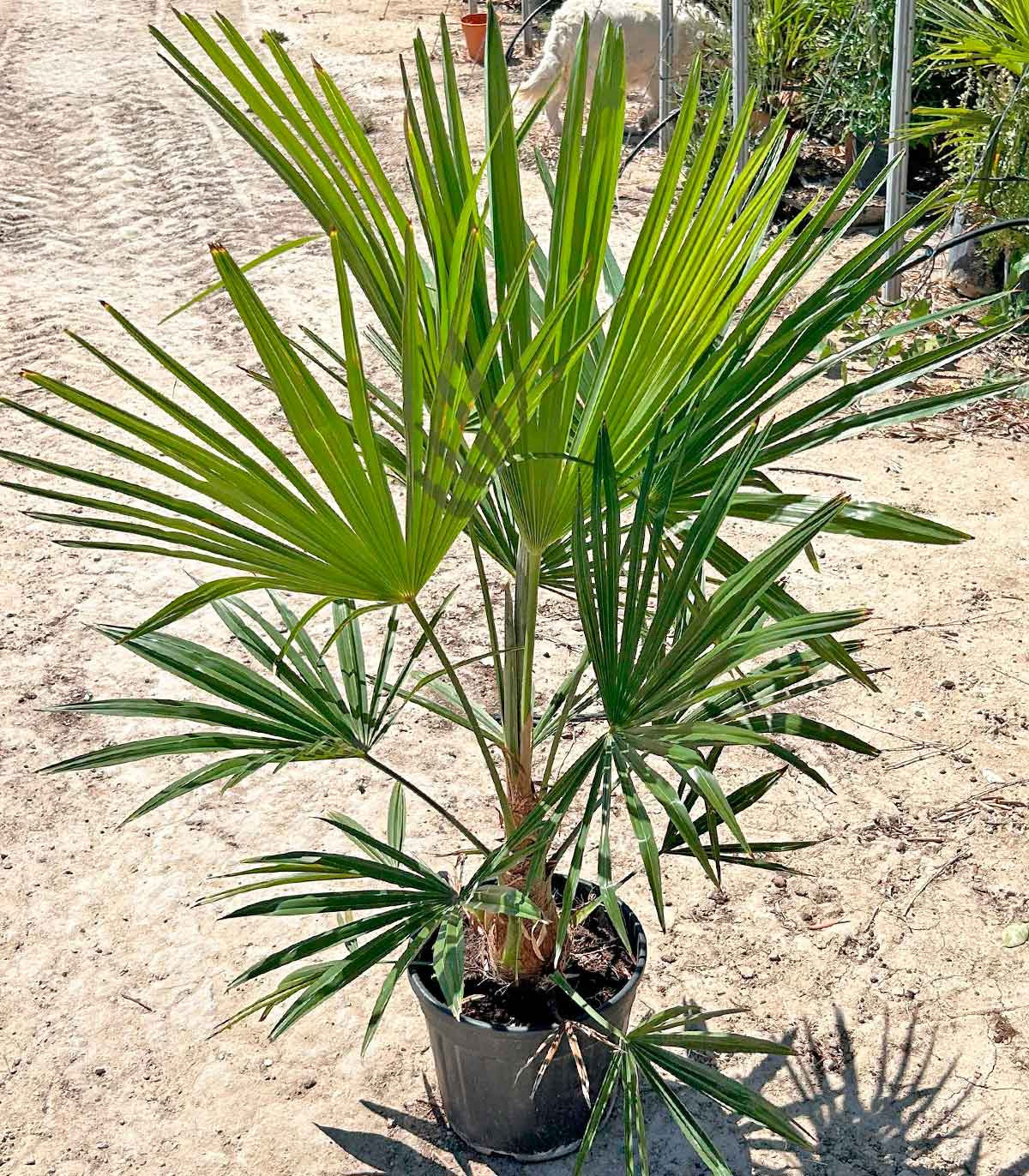
Palm native to the far east characterized by a solitary columnar trunk, unbranched and not shrubby at the base, covered with a dense tangle of brown fiber, which grows rather slowly, reaching a height of 10-12 m.
A palm native to the Far East, characterized by a solitary, columnar trunk, unbranched and not shrubby at the base, covered in a dense tangle of brown fibers. It grows rather slowly, reaching a height of 10-12 meters. Each year, new evergreen, fan-shaped leaves develop at the tip of the trunk. These leaves are composed of 35-40 segments, dark green and glossy on the upper surface and light green and ashy on the underside, supported by robust petioles with spiny edges. The lower leaves fall all at once, leaving the base of the petiole attached to the trunk. In late spring, long, drooping panicles of small yellow flowers form just below the leaves, followed by clusters of semi-spherical, blue-black fruits. It is not at all demanding regarding soil (it just needs to be well-drained or not excessively clayey), is very easy to grow in containers, and is the only palm sold for areas with snow and ice.
Physiological and cultivation characteristics:
- It can reach a height of 10 to 12 meters and a width of 2.5 meters.
- It belongs to the 8B rusticity zone.
- It is slow-growing.
- It should be in an area with full sun or partial shade.
- Suitable for small gardens.
- Suitable for parks or large gardens.
- Suitable for rock gardens.
- It can be grown in pots, planters and flower boxes to decorate terraces, balconies, etc.
- It can be planted individually but is also suitable for forming groups (more plants of the same variety).
- Suitable for the formation of patches and groves with other different species.