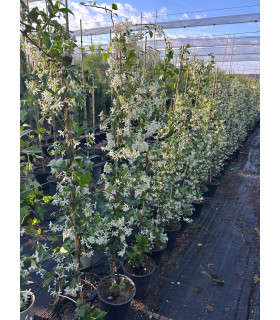

Star Jasmine, Rhyncospermum jasminoides or Trachelospermum jasminoides, is the perfect choice. With its delicate, star-shaped white flowers and intoxicating fragrance, this plant has become a classic for gardens and balconies.
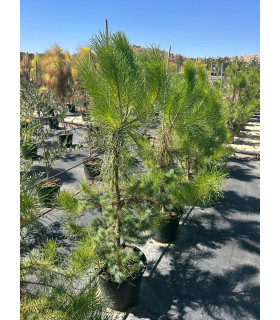
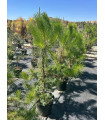
The Canary Island pine is a tree that can reach up to 60 meters in height, with a lobed crown in older specimens and a conical crown in younger ones. The buds are covered by numerous intertwined cataphylls, giving the tree a highly ornate appearance.
The Canary Island pine is a tree that can reach up to 60 meters in height, with a lobed crown in older specimens and a conical crown in younger ones. The buds are covered by numerous intertwined cataphylls, giving the tree a highly ornate appearance. The needles are very long, measuring 20 to 30 cm, thin and flexible, and glaucous green. It has large cones, 10 to 18 cm long. It is native to the Canary Islands but is widespread throughout the mild climate zones of the Iberian Peninsula. It is resistant to summer drought but sensitive to intense winter cold and very calcareous soils. The Canary Island pine has become popular as an ornamental tree in gardens in many countries around the world. Its ability to resprout along its entire trunk makes it suitable even for use as a hedge.
It readily produces adventitious buds all along the trunk and at the stump when cut. Old trees lose the ability to sprout from the stump. Its wood is very resinous and aromatic. In the past, it was harvested in the Canary Islands for its highly prized heartwood, but today logging is prohibited. On the Iberian Peninsula, it was planted to take advantage of its ability to sprout after fire. It is a species widely used in landscaping in many countries around the world.
Physiological and cultivation characteristics:
- It can reach a height of 50 to 60 meters and a width of 4 to 6 meters.
- It belongs to rusticity zone 10.
- It grows very quickly.
- It must be in an area exposed to full sun.
- Suitable for parks or large gardens.