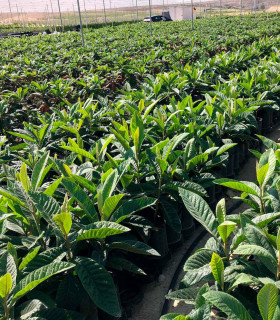

The Strelitzia reginae, or Bird of Paradise, is a plant native to South Africa. It has large, dark green, leathery, oblong leaves with long petioles. These are arranged in two rows, forming a fan-shaped crown. Its exotic and striking flowers are a deep orange with a bright blue base. They are shaped like a bird's beak, with three sepals and three petals. They appear in spikes of up to six flowers.
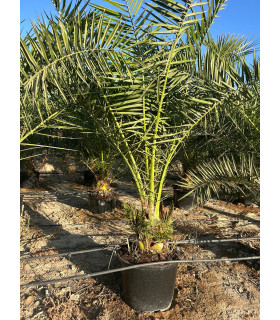
The Santolina, also known as southernwood or cypress, is the perfect choice. This little wonder of nature will captivate you with its silvery foliage and button-like yellow flowers.
Pot: 6L / 20-40 cm
The Santolina, also known as southernwood or cypress, is the perfect choice. This little wonder of nature will captivate you with its silvery foliage and button-like yellow flowers.
Characteristics of Santolina
Santolina (Santolina chamaecyparissus) is a perennial subshrub belonging to the Asteraceae family. Native to the Mediterranean regions, it has become a very popular ornamental plant worldwide.
- Foliage: Its leaves are small, narrow, and grayish-green, giving it a very attractive silvery appearance. They also give off an intense aroma reminiscent of chamomile.
- Flowers: During spring and summer, the Santolina is covered in small, golden-yellow flower heads, which contrast spectacularly with the silvery foliage.
- Size: Its height usually ranges between 20 and 70 centimeters, making it an ideal plant for rock gardens, borders and small gardens.
Benefits of growing Santolina
- Repellent properties: The intense aroma of Santolina acts as a natural insect repellent, such as mosquitoes and moths, making it an excellent choice for growing in gardens and terraces.
- Medicinal use: Traditionally, Santolina has been used for its medicinal properties, such as digestive, anti-inflammatory and antispasmodic.
- Low maintenance: This plant is very resistant to drought and high temperatures, so it requires little care. It also tolerates pruning well, allowing it to be kept compact and with a defined shape.
Santolina Care
- Location: Santolina prefers sunny places protected from the wind.
- Soil: It adapts to all types of soil, although it prefers well-drained soils that are poor in nutrients.
- Watering: It needs moderate watering, always waiting for the soil to dry between waterings.
- Pruning: It is recommended to prune Santolina after flowering to encourage the growth of new shoots and maintain a compact appearance.
Uses in gardening
Santolina is a very versatile plant that can be used in different types of gardens:
- Rock gardens: Thanks to its compact size and drought resistance, it is ideal for creating rock garden compositions alongside other Mediterranean plants.
- Borders: Used to create low and formal borders, delimiting different areas of the garden.
- Mass plantings: It can be part of mixed mass plantings, combining it with other plants of different colors and textures.
- Aromatic gardens: Its intense aroma makes it an essential plant in aromatic gardens.